
Artificial intelligence is becoming increasingly useful in education, but schools need tools that are designed specifically for learning rather than simply adapting general-purpose AI platforms. SchoolAI is an education-focused AI platform designed to help teachers create interactive learning experiences while giving students access to guided AI-powered learning environments.
SchoolAI provides tools that educators can use to create AI-powered learning activities, monitor student interactions, and support personalized learning. Students can interact with AI through teacher-created or education-focused experiences while educators retain visibility into the learning process.
In this SchoolAI Review, we’ll explore its AI learning tools, teacher features, student experience, classroom applications, website usability, pricing considerations, privacy, and overall value to help you decide whether SchoolAI is worth considering.
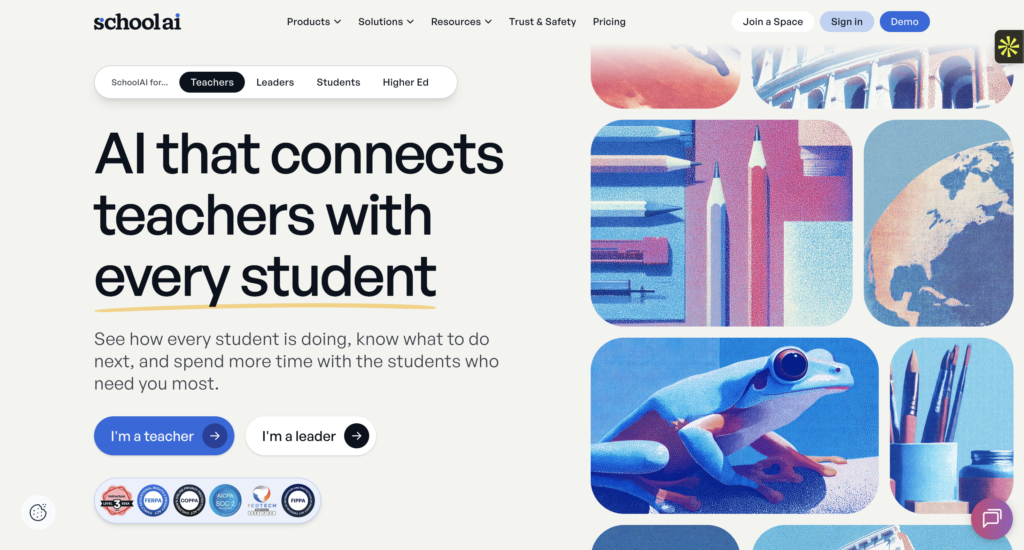
About SchoolAI
SchoolAI is built specifically around the needs of teachers, students, and schools.
Rather than positioning AI simply as a general chatbot, the platform focuses on using AI as part of the learning process.
It can support activities such as:
- Personalized learning
- AI tutoring
- Classroom activities
- Student practice
- Writing assistance
- Subject-based learning
- Interactive learning experiences
- Teacher-created AI activities
This education-first approach makes it different from general AI tools that aren’t specifically designed for classroom use.
What Makes SchoolAI Different?
One of SchoolAI’s key ideas is giving teachers more control over how students interact with AI.
Educators can use AI-powered learning experiences to create more interactive lessons while maintaining visibility into student activity.
This can help teachers:
- Create engaging activities
- Personalize learning
- Provide additional practice
- Support students individually
- Explore student interactions
- Save time on certain classroom tasks
The goal isn’t simply to have students ask an AI questions, but to make AI part of a structured educational experience.
AI-Powered Learning
Students can interact with AI-based learning experiences designed around particular subjects, topics, or classroom goals.
This can be useful for:
- Explaining difficult concepts
- Practicing skills
- Asking follow-up questions
- Exploring topics
- Getting guided feedback
- Reviewing material
The interactive nature of AI can allow students to learn at their own pace instead of relying exclusively on a single explanation delivered to an entire class.
Teacher Tools
Teachers are an important part of the SchoolAI experience.
The platform is designed to help educators create and manage AI-supported learning activities.
Teachers can potentially use AI to support:
- Lesson activities
- Student practice
- Personalized learning
- Writing exercises
- Subject-specific activities
- Classroom engagement
This can reduce some of the repetitive work involved in creating additional learning resources.
Student Experience
For students, the appeal of SchoolAI is the ability to interact with learning material in a conversational and personalized way.
Instead of simply reading information, students can ask questions and receive responses based on the learning experience they’re using.
This can encourage:
- Curiosity
- Active participation
- Independent learning
- Question asking
- Practice
- Deeper exploration
However, students still need guidance because AI-generated responses can occasionally be inaccurate or incomplete.
Personalized Learning
One of the strongest potential advantages of AI in education is personalization.
Students don’t all learn at the same pace or in the same way. AI-powered learning experiences can provide additional explanations or practice when a student needs them.
For example, a student struggling with a particular concept can spend additional time working through it, while another student can move ahead.
This makes AI particularly interesting as a supplementary learning tool.
Classroom Applications
SchoolAI can be used across different subjects and classroom situations.
Potential applications include:
Language and Writing
Students can use AI-powered activities to practice:
- Writing
- Reading comprehension
- Vocabulary
- Grammar
- Creative writing
- Discussion
Mathematics
AI can provide additional opportunities to:
- Practice problems
- Work through concepts
- Ask questions
- Review mistakes
- Receive guided explanations
Science
Students can use interactive AI experiences to explore:
- Scientific concepts
- Experiments
- Problem-solving
- Subject-specific questions
Social Studies
AI can support:
- Historical exploration
- Discussion
- Research preparation
- Concept review
- Critical-thinking activities
The usefulness ultimately depends on how the teacher structures the activity.
Teacher Visibility and Monitoring
One of the more important considerations when using AI with students is teacher visibility.
SchoolAI is designed around giving educators insight into student interactions with AI-powered learning experiences.
This can help teachers understand:
- What students are working on
- Where students may be struggling
- How students are interacting with learning activities
- Where additional support may be needed
This is particularly valuable because completely unsupervised AI use can make it difficult for educators to understand how students are actually learning.
AI Safety and Education
AI tools used by students require additional safeguards compared with ordinary consumer chatbots.
SchoolAI’s education-focused approach is intended to provide a more structured environment for student-AI interactions.
Schools and teachers should nevertheless review the platform’s current policies regarding:
- Student data
- Privacy
- Account management
- AI safety
- Data retention
- School-level controls
Requirements can also differ depending on the age of students and the school’s policies.
Website Experience
The SchoolAI website is designed primarily for educators and schools interested in incorporating AI into learning.
Visitors can explore information about:
- AI-powered education
- Teacher tools
- Student learning
- Classroom applications
- School solutions
- Platform features
The education-focused presentation makes it relatively easy for teachers and administrators to understand the purpose of the platform before deciding whether to explore it further.
Ease of Use
A major factor in educational technology is whether teachers can actually use it without spending excessive time learning complicated software.
SchoolAI’s focus on classroom applications and teacher-created learning experiences can make it useful for educators who want to experiment with AI without building their own AI systems.
However, the learning curve will depend on how extensively a school chooses to use the platform.
Pricing and Overall Value
The value of SchoolAI depends on the features available to the specific educator, school, or district and the current pricing structure.
When evaluating an education AI platform, schools should consider:
- Teacher tools
- Student access
- Classroom management
- Monitoring features
- Privacy controls
- Available integrations
- Support
- Number of users
- Administrative features
For individual teachers, the value can come from saving preparation time and providing students with additional learning opportunities.
For schools and districts, factors such as privacy, administration, scalability, and teacher adoption become even more important.
Who Should Choose SchoolAI?
SchoolAI may be particularly suitable for:
- Teachers
- Schools
- School administrators
- Educational institutions
- Students
- AI-forward classrooms
- Educators experimenting with personalized learning
It’s especially relevant for teachers who want to use AI as a structured teaching assistant or learning environment rather than simply allowing students to use a general-purpose chatbot.
Is SchoolAI Worth It?
SchoolAI can be worth considering if your goal is to introduce AI into education in a more structured and teacher-guided way.
Its biggest advantage is the education-specific focus. Teachers can use AI-powered experiences to supplement lessons and provide students with additional opportunities for practice and exploration.
However, AI shouldn’t replace teachers or traditional instruction. Educators should continue reviewing AI-generated information and guiding students toward critical thinking and independent reasoning.
Schools should also evaluate the platform’s current privacy, student-data, safety, and administrative policies before adopting it at an institutional level.
Final Verdict
SchoolAI offers an education-focused approach to artificial intelligence, bringing AI-powered learning experiences into the classroom while keeping teachers involved in the process. Its focus on personalized learning, interactive activities, student engagement, and teacher visibility makes it more tailored to education than a standard general-purpose AI chatbot.
The platform can be particularly useful for educators who want to experiment with AI while maintaining a structured learning environment. Its potential to provide additional practice and personalized support can also be valuable for students with different learning needs and paces.
Overall, this SchoolAI Review finds that SchoolAI is worth exploring for teachers and schools interested in incorporating AI into the classroom. If you’re looking for an education-specific AI platform that can support personalized learning and make classroom activities more interactive, SchoolAI is a strong option to consider.